
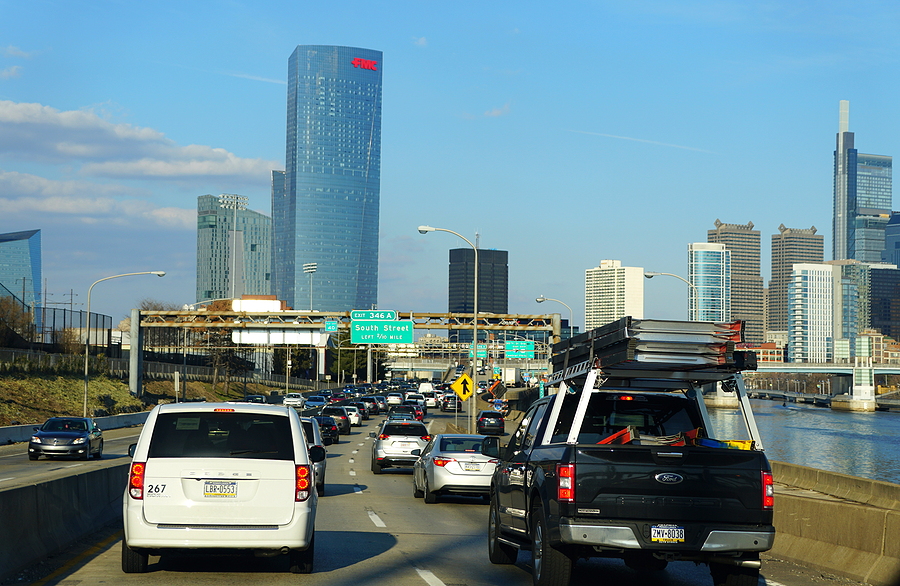
The Schuylkill Expressway is legendary for its traffic jams, and construction on I-95 has been frustrating drivers for years. In late winter, Philadelphia has pothole season. And, to make matters worse, the city is rife with confusing signage and with rude drivers who brandish their middle fingers with abandon.
And parking? Fuhgeddaboudit!
So perhaps it’s no surprise that a new WalletHub analysis has named Philadelphia the worst city in America for drivers.
In a ranking of the nation’s 100 largest metropolitan areas, Philly came in dead last—even behind New York City, which was fourth from the bottom.
The best city for drivers, according to WalletHub, is Corpus Christi, Texas, followed by Greensboro, N.C., Boise, Idaho, Scottsdale, Ariz., and Laredo, Texas.
The analysis evaluated cities based on factors such as gas prices, congestion, and road maintenance. Other criteria included the cost of owning and maintaining a car, parking expenses, and overall safety—something many Philadelphians might equate with their odds of being carjacked.
Birmingham, Ala., boasts the least-expensive auto repair costs, while New York City tops the list for the most costly. Parking is cheapest in Corpus Christi and most expensive in San Diego, Calif.
Weather was another factor. Researchers counted days with precipitation, noting that Las Vegas had the fewest and Buffalo, N.Y., the most.
In Boise, drivers are nearly 23 percent less likely to have an accident than the national average. The Idaho capital also has the fewest uninsured drivers, the fewest “hard-braking” drivers, and the second-lowest auto theft rate.
Delaware Valley residents aren’t surprised by the results.
“Car prices have gone up significantly over the past few years, and gas remains expensive going into the summer travel season,” said Chip Lupo, a WalletHub analyst. “Living in one of the best cities to drive in can make owning and maintaining a car much cheaper. However, costs aren’t the only factors that matter; the best cities for drivers also minimize commute times and traffic congestion, have accident rates well below the national average, and keep their roads in good condition.”
Joy Schwartz of Delaware County said she avoids driving into Philadelphia whenever possible.
“I used to drive into Center City and all parts of Philly all the time,” Schwartz said. “After two to three years of avoiding it at all costs, I forayed in a couple of weeks ago. The gridlock getting home was a nightmare! Whoever had the lame idea for bike lanes on the arterials needs to have their head examined. Way to choke off business!”
Nikki Gaston of Montgomery County cited the constant roadwork.
“Many of the roads are under repair, which slows down traffic,” she said. “There are detours causing drivers to take alternate routes. I suppose it’s not a whole lot different from other major cities having the same issues.”
Mona Chipman of Bucks County said she fears crime in the city more than traffic.
“All one needs to do is drive through Kensington to know that Philadelphia has abandoned all sense of responsibility and dignity toward its citizens in desperate need of protection and help,” Chipman said. “It’s a national disgrace.”
Jana Tidwell, a spokesperson for AAA, said the WalletHub report could be “misleading.”
“When you consider driving in Philadelphia, you have to remember it wasn’t designed for the volume of traffic we see today,” Tidwell said. “More people and more cars result in congestion, limited parking, and other issues.”
The same is true for the Schuylkill Expressway—it wasn’t designed for today’s traffic volume, nor can it be expanded, since it runs between the river and steep cliffs.
Tidwell added that modern traffic volumes have taken a toll on roadways.
“That’s why infrastructure funding is critical to keep our roadways and bridges safe,” she said.
Both PennDOT and the City of Philadelphia declined to comment.