
While college graduates worry that artificial intelligence may replace them in the workforce—after paying sky-high tuition—students in Pennsylvania’s career and technical high schools are finding themselves in demand.
A recent Wall Street Journal report noted that labor force participation among the class of 2023 actually dropped a year after graduation, a reversal of the trend for graduates in 2020, 2021, and 2022.
By contrast, students who earn vocational, career, or technical certificates or associate degrees are faring far better. About 75 percent find work within six months, compared to only 60 percent of bachelor’s degree graduates, according to CollegeVine.
That helps explain why Delaware County Technical High Schools (DCTS) are at full capacity.
“All of our programs are at 100 percent enrollment, and they have been for the past several years,” said Daniel Palmer, Ed.D., principal at the Folcroft campus.
For many families, “vo-tech” still sounds like a fallback option. But today’s career and technical education (CTE) is designed to launch students directly into skilled careers—or prepare them for further education.
“It sounds cliché to say, but we’re not the old vo-tech anymore,” said Christian Hansen, principal of the Aston campus. “We really are focused on creating pathways for students. We have students who come to us to get training to be a welder, but they really want to be an engineer.”
At DCTS, students from all 15 county school districts—as well as five parochial high schools—can begin attending in 10th grade. They split their day between traditional academics and specialized training in one of 25 career clusters, ranging from health and biosciences to construction technology, computer science, and logistics.
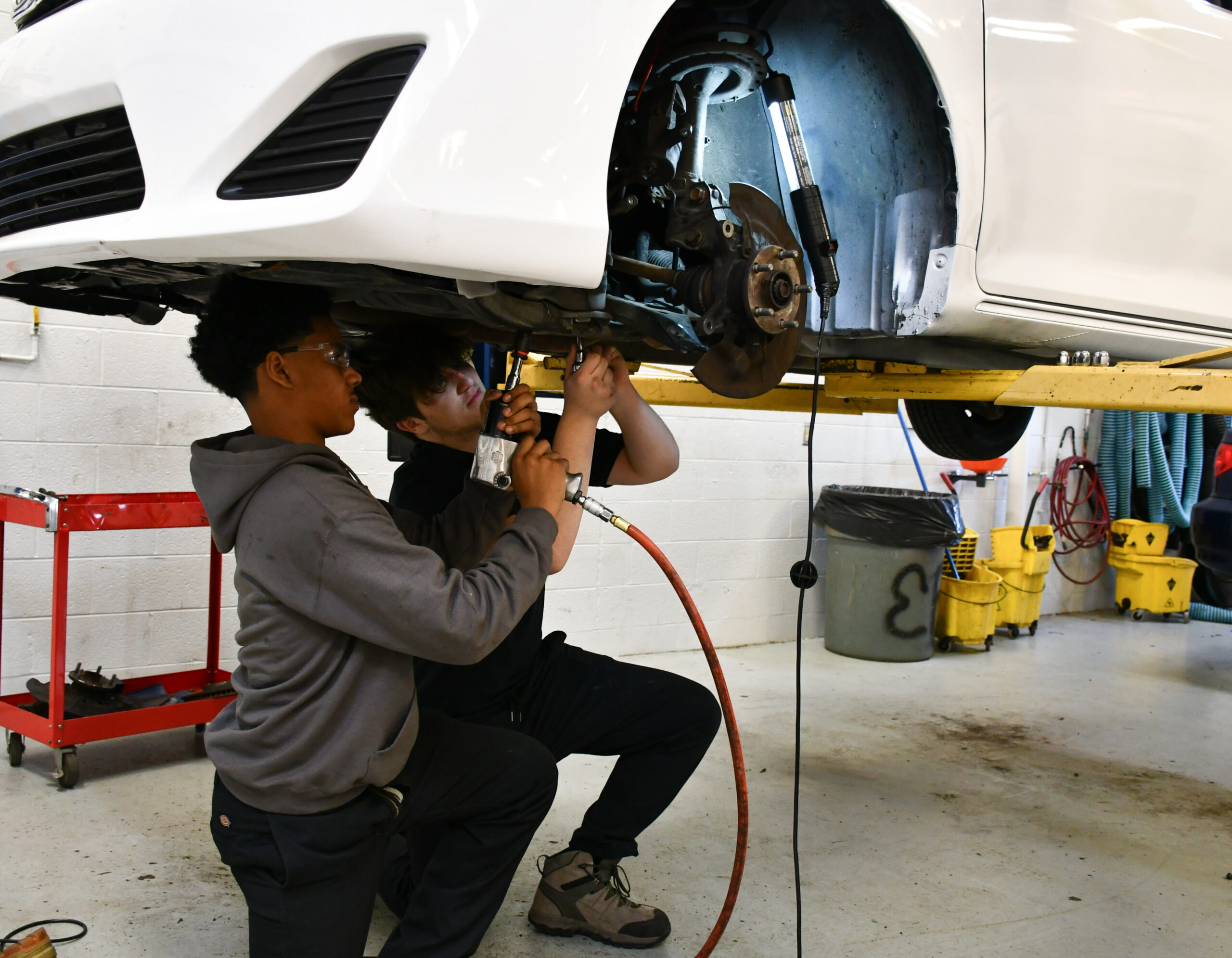
Each campus enrolls about 700 students. Both campuses offer construction programs. Folcroft also offers automotive and emergency services.
What sets technical schools apart is how closely they connect students with employers during high school.
“About half of our graduates go on to college, but about half go right into the field,” said Palmer. “Some of our certifications are national or state certifications.”
In automotive programs, for instance, students partner with local dealerships and pursue brand-specific certifications from Ford, BMW, Toyota, Subaru, or Chevrolet. In health care, they intern at hospitals, dental practices, and medical offices. Students in the building trades often join unions as apprentices even before they graduate.
“When students go into cooperative education and their apprenticeship, they’re working for companies that have job openings after they graduate,” Palmer said. “They pretty much will have job offers.”
Local businesses know it, too. “Right now, Garnet Ford is asking to take two kids that he’s had working for him this past year and take them again this year. And usually, they’ll offer them full-time jobs,” Palmer added.
Delaware County isn’t unique. Technical schools are thriving across Pennsylvania.
At the Middle Bucks Institute of Technology, which draws about 1,000 students from four school districts, demand is just as strong.
“All of our programs are popular, and career and technical education is surging nationwide,” said Mark Covelle, Ed.D., the school’s administrative director. “We see a lot of interest in our medical areas as well as automotive, cosmetology, culinary, electrical, and welding.”
Like Delaware County’s schools, Middle Bucks offers apprenticeships that transition students straight into jobs—or continue on to college.
“CTE and college is certainly a pathway,” said Covelle. “It is no longer college or career. It is most certainly college and career. In the end, all education is career education.”
At DCTS, Hansen emphasizes that technical schools are not just for one type of student—they are meant to prepare an entire community for the labor market of the future.
“We’re a school that’s open to all students, no matter their academic acumen. There’s something for everyone here,” he said. “We emulate a professional work environment. Students wear uniforms. They uphold safety standards. It provides a taste of adulthood.”
And as AI reshapes the job market for college graduates, technical high school students may have an edge: hands-on experience, credentials that employers recognize, and connections to industries that need them now.
“We’re a community asset,” Hansen said. “We’re here to train the workers who are going to fulfill the needs of our local communities.”