
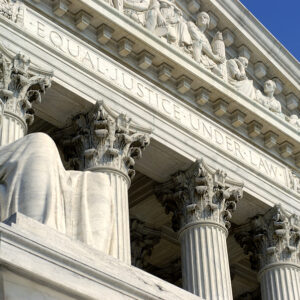
The Public Interest Legal Foundation (PILF) is asking the U.S. Supreme Court to review a decision by a lower court regarding the refusal by the state of Pennsylvania to turn over voter records.
Pennsylvania is a crucial swing state in presidential elections.
Pennsylvania officials publicly admitted that, for decades, the Department of Motor Vehicles had allowed non-U.S. citizens to register to vote through the state’s “motor voter” system. According to the state’s own analysis, “approximately 100,000 registered voters may potentially be non-citizens or may have been non-citizens at some point in time,” a spokesman for PILF said.
PILF had requested the records under the National Voter Registration Act (NVRA). That law has a provision requiring states to make list-maintenance documents available for public inspection.
However, the Third Circuit ruled against PILF, overturning a lower court ruling. And PILF believes that decision, which other courts are citing, was an error. PILF argues the Third Circuit applied TransUnion LLC v. Ramirez, which was a case involving private credit reports to a public records dispute.
“The public has a right to know how election officials handle errors that place ineligible names on the voter rolls,” said PILF President J. Christian Adams. “Transparency in voter list maintenance is not optional.”
The Department of State, which oversees elections, declined to comment on PILF’s petition.
“If a voting rights organization like the Foundation does not have standing here, then virtually no one does, and the transparency Congress intended does not exist,” the petition stated. “As a result of this decision, other courts are now limiting access to public documents across the country.”
“This case drives yet another wedge in the deepening conflict between the circuits on whether a litigant must plead additional harm beyond the denial of public information,” the petition said. “Because of this conflict, someone’s rights under a federal voting law now depend on the area of the country in which the person resides. A stark circuit split involving an exceptionally important issue requires this Court’s attention.”
“Now, this Court has the perfect opportunity to definitively state the proper standard for public record informational injury claims,” the petition said. “The straightforward record in this case provides this Court the vehicle to provide clarity. The statute at issue expressly provides a right to information— precisely like FOIA (Freedom of Information Act) does.”
Further, “the underlying decision changed the established standard for standing and created an insurmountable hurdle for those seeking redress for the denial of public records, not just for the Foundation but for requesters across the nation. This case is the ideal vehicle for this Court to clarify its Article III jurisprudence,” the petition said.
PILF lawyer Linda Kerns, who practices election law in Philadelphia, said they don’t know yet if the high court will take the case.
“We hope they act quickly, as this is a case concerning deeply problematic transparency and voter roll issues, as well as what Congress intended when it enacted the National Voter Registration Act in 1993 (NVRA).
“Secretary (of State Al) Schmidt, when he was a commissioner in Philadelphia, admitted that up to 100,000 active registrants on their rolls may have been noncitizens, yet Pennsylvania refuses to release the complete records showing how it happened or how they fixed it. If the public can’t see how election officials handle these mistakes, there’s no accountability as anticipated by the NVRA,” said Kerns.
DVJournal asked Kerns what difference it makes, out of millions of voters, if 100,000 noncitizens are voting.
“Every unlawful vote dilutes the voice of lawful voters,” said Kerns. “Federal law states both that only citizens can vote in federal elections, and that states are required to keep accurate rolls to prevent ineligible registrations. Transparency about how these errors occur helps protect both the integrity of elections and the rights of legitimate voters. Pennsylvanians, and all Americans, deserve better.”