
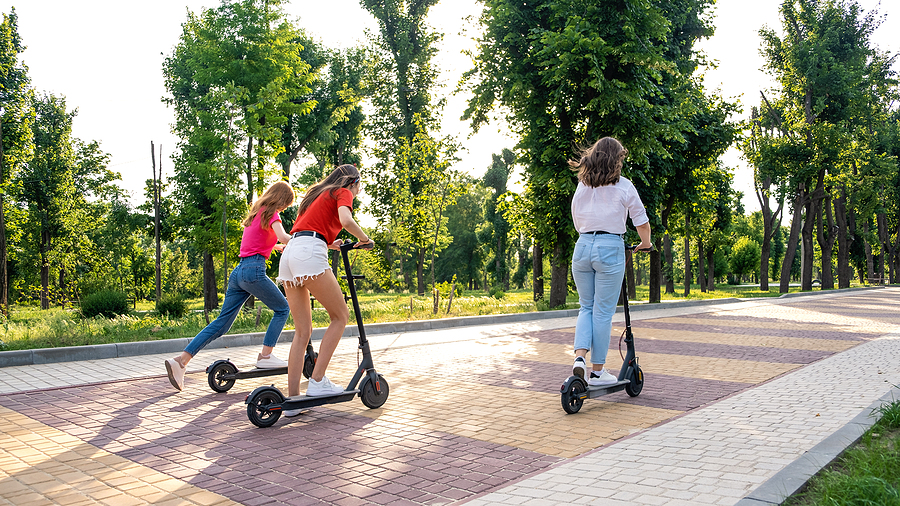
This summer, four teens riding double on electric scooters (e-scooters) in Delaware County were struck by vehicles, resulting in the death of one teen and critically injuring two others. That tragic incident prompted the commissioners of Ridley, Springfield, and Haverford Townships to invoke safety ordinances regarding these emerging micro-motorized vehicles.
In addition, state officials are considering how to best categorize and regulate these micro-transportation units to balance their benefits with necessary safety measures, as this new group vies to “share the road.”
There is something endearing about seeing youngsters scooting by while we walk or drive through the neighborhood. Similar to psychologist Jordan Peterson’s rule to “not bother children when they are skateboarding,” navigating an e-scooter allows teens—during such a formative stage of life—to test boundaries, face danger, and build self-efficacy in a reasonably safe environment, all of which are healthy for psychological development.
E-scooters offer several community benefits, including reducing air pollution and road congestion. Their compact size allows for more units to be parked in smaller spaces at schools, workplaces, commercial strips, and parks and recreation areas. They are also easy to use and can be disembarked quickly.
Short of walking, e-scooters rank as one of the most cost-effective means of getting around town, making them accessible to those who can’t afford electric bikes or cars.
We should not wait for a Ralph Nader-style report for public officials, users, and families of young users to call for commonsense ordinances to prevent injuries. Such regulations should address who is permitted to operate e-scooters, where they can be used, and what types of scooters are allowed.
Regarding the “who,” it is reasonable to establish the minimum operating age at 14 or 15, aligning with the age when most teens are in high school. While middle and elementary school students and their parents may object, higher age requirements generally lead to more responsible use, as older teens are likely to have sharper senses and better judgment. State Sen. Tim Kearney (D-Delaware) has introduced legislation to prohibit children under age 16 from riding e-scooters.
Similar to age requirements for bicycle use, all e-scooter operators, especially those under 18, should wear helmets that meet impact standards. This requirement should be strictly enforced, considering the risks of head injuries associated with bicycle riding and the often higher speeds of e-scooters.
While Pennsylvania has some restrictions on e-scooter operation, these are evolving at both the state and local levels. There is a paradox at play: while officials have granted riders tacit approval to use e-scooters in more public venues over the past few years, they have also grown increasingly concerned by reports of serious injuries among e-scooter users.
Sidewalks may seem safer for e-scooter use, but they are primarily meant for pedestrians—often with dogs in tow– joggers, and young children using other rolling units.
More traffic and higher speeds on roads designed for vehicles increase the risk associated with e-scooter usage. It makes sense that e-scooters should be allowed on designated bike paths. However, many cyclists may not be enthusiastic about sharing the road with them.
E-scooter use should be prohibited at night for those under 18, and if operators are of age, their scooters should be equipped with reflectors and adequate lighting both front and rear. Manufacturers should create e-scooters with adjustable speed options, ensuring that those under 18 have access to lower-speed units only.
Registering e-scooters with local municipalities and providing owners with documentation can deter theft for both short-term and long-term use. This registration process could help officials track stolen scooters, similar to existing systems for bicycles. Moreover, registered scooters could facilitate the enforcement of ordinances through warnings and fines, with the revenue from fines supporting enforcement efforts.
Further ideas can be discussed to enhance the prevention and protection of e-scooter users. While no one wants to see teens get hurt while enjoying rides in our neighborhoods, it’s crucial for drivers in the county to practice safe and defensive driving. One immediate step that should not take months of deliberation is for officials to initiate a safety awareness campaign for e-scooter users, vehicle drivers, and guardians of the young users.