
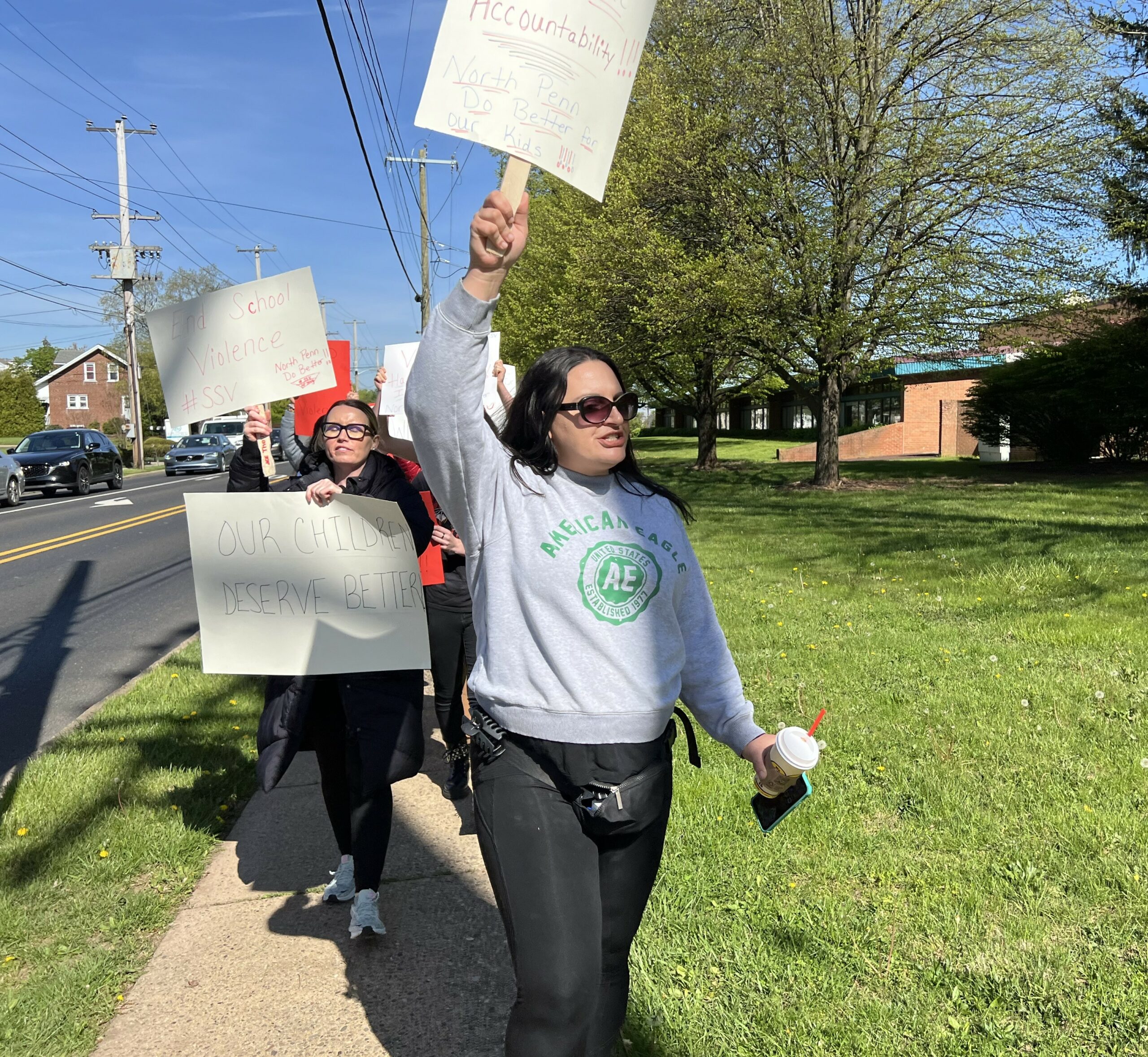
North Penn School District parents and students staged a protest last year after a 12-year-old girl was assaulted in the lunchroom —hit with a metal Stanley tumbler by another student. That school is one of 27 in the Delaware Valley identified as “persistently dangerous” in a new report from the Commonwealth Foundation, a free-market think tank.
The entire list of collar county school districts can be found here.
The report claims violence in Pennsylvania public schools is widespread—even in suburban districts—and accuses the state Department of Education of violating federal and state law by failing to label about 40 percent of dangerous schools. That failure, Commonwealth says, not only denies families options to transfer their children to safer schools but also risks billions in federal funding.
In May 2025, the U.S. Department of Education directed states to update their definitions of “persistently dangerous” and strengthen enforcement procedures, warning of possible penalties for noncompliance. The Commonwealth Foundation says Pennsylvania has not met those requirements.
A spokeswoman for the Pennsylvania Department of Education did not respond to requests for comment.
Rachel Langan, the foundation’s senior education policy analyst, said the state’s inaction has “real consequences.”
“It leaves hundreds of thousands of children stuck in unsafe schools and denies families the legal options designed to protect students from violence,” Langan said. “Children cannot learn if they do not feel safe. Ignoring the law to avoid uncomfortable political pressures does nothing to protect our kids—and raises serious questions about this administration’s priorities.”
Both federal and state law require that students attending a persistently dangerous school be offered a transfer to a safe school, either within their district or in a neighboring district. Pennsylvania defines a school as persistently dangerous based on incidents resulting in arrest over two or more of the past three school years. For a school with 251 to 1,000 students, incidents must equal at least two percent of enrollment; smaller schools must report at least five incidents.
An independent analysis found that 37.3 percent of Pennsylvania’s 3,000 public schools meet the “persistently dangerous” threshold. Weighted by enrollment, nearly half—47.1 percent—qualify.
The Commonwealth Foundation says 27 of the 88 school districts in the Philadelphia collar counties have high incident rates—around 10 percent based on enrollment. That includes Norristown Area School District (Montgomery County), with a 7.85 percent average incident rate over 10 years; Southeast Delco (Delaware County), 11.22 percent; and William Penn (Delaware County), 10.17 percent.
Erik Telford, the foundation’s senior vice president of public affairs, said the group set a high threshold to focus on the most at-risk districts.
“A lack of transparency in data at the individual school level, reliance on self-reporting by schools, and non-compliance with state law make it a challenge to pinpoint the specific individual schools that qualify,” said Telford. “These challenges are the basis for the Trump administration’s directive, which calls on states to review and ensure compliance with safety standards. This isn’t isolated to Pennsylvania, as recent reporting in Maryland shows a similar issue.”
Some schools were cleared of the “dangerous” designation, including Upper Bucks County Technical School, Delaware County Technical High School, Western Montgomery CTC, and two cyber charter schools—21st Century Cyber CS and Achievement House CS.
The Commonwealth Foundation has submitted its findings to the U.S. Department of Education, which has requested a meeting. The group says it will continue pushing for a full investigation and legislative action to ensure school safety—and to expand school choice options for families in persistently dangerous schools.