
On Aug. 21, someone called Villanova University to say there was an active shooter on campus.
Police swarmed in response. Officers from local departments, the state police, and federal agencies flooded the campus. The risk of injury to an officer or student soared.
But the call was a fraud — a fake. The college had been “swatted.”
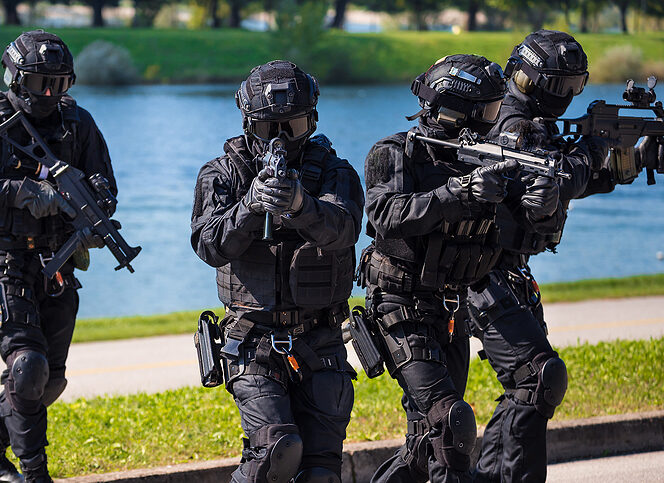
“Swatting” is the act of making hoax reports of serious crimes to emergency services to prompt a major police response, often involving a Special Weapons and Tactics (SWAT) team. Targets have included politicians such as Republican Gov. Nikki Haley of South Carolina and Michelle Wu, the Democratic mayor of Boston.
Several swatting incidents have resulted in injury or even death, including a 2017 call to Wichita, Kan., police falsely reporting a murder and hostage situation. Andrew Finch was killed when he came to the front door of his own home. The call originated from a dispute over an online video game.
While swatting is a federal crime, Pennsylvania has no corresponding state law.
Hoping to change that, Rep. Craig Williams (R-Chester/Delaware), a former federal prosecutor, held a press conference Tuesday to announce two bills. One would make swatting a felony. The other would require offenders to pay restitution.
“We’ll make certain that those who weaponize fear with false reports will be held fully accountable in the Commonwealth of Pennsylvania,” Williams said. “We have more than 20 co-sponsors on each bill,” he added, noting “bipartisan support.”
“If you terrorize the public with false calls, it is an act of violence and you will be punished,” Williams said. “It is time for Pennsylvania to act decisively to give law enforcement the tools they need to stop this threat before it takes lives.”
Delaware County District Attorney Jack Stollsteimer recalled responding to Villanova’s campus during the swatting incident and seeing terrified people running.
“It was the first day of the semester,” he said. “A lot of students were moving in.”
“There were literally dozens of police officers from three counties who responded,” Stollsteimer said, calling them heroic. “These officers were running toward danger with one thought in mind: to try and stop somebody from killing the students. As I was there, I could see the fear in the parents’ eyes.”
If members of the legislature could see that fear and hear parents asking whether their kids were OK, Stollsteimer said, he is certain they would vote to pass these bills. The FBI has led the investigation, and he believes they are close to charging a suspect.
There have been multiple swatting incidents, Stollsteimer added. That same day, a hoax call was also placed to the King of Prussia Mall and to Grove City College in western Pennsylvania.
“We need to hold people accountable,” Stollsteimer said. “And in some ways, more important than holding people accountable is deterring.”
“It was a terrifying day. My district manager’s son was on campus [at Grove City] that day, and she texted me immediately in a panic,” said Rep. Jill Cooper (R-Westmoreland). “It is imperative that we have this type of legislation. As they mentioned, I was not aware that this wasn’t already a crime.”
“This is something that, as a mother, you never want to see,” she added.
Rep. Lisa Borowski (D-Newtown Square), whose district includes Villanova, said, “Swatting is not funny and it is not a joke. Sadly, these incidents are becoming all too frequent, costing time, money, and an immeasurable amount of pain and suffering. I agree it is time to give our law enforcement and judiciary the tools they need to deter those who would seek to terrorize our communities.”
Radnor Police Chief Chris Flanagan agreed the anti-swatting bills are “much needed.”
He hopes they’ll pass and act as a deterrent to would-be swatters.
Advancements in technology, including artificial intelligence, make it easier for callers to conceal their identities when making swatting calls, he said. Often, the perpetrators are juveniles, and the bill allows for education programs to help them understand the seriousness of swatting.
As for restitution, Flanagan noted the costs of manpower, property damage, and the time of first responders, including fire and EMS personnel diverted from other calls, as well as the cost of operating vehicles such as firetrucks.
“I hope it passes,” Flanagan said. “I’m very excited for it to come through.”