

As Pennsylvania faces a worsening childcare crisis, Bucks County lawmakers are proposing a bold new plan: training the next generation of daycare teachers while they’re still in high school.
Bucks County GOP state Reps. Joe Hogan and Shelby Labs announced their intention Tuesday to introduce legislation creating a pilot program that would allow high school students to earn an associate degree and professional certifications in early childhood education through career and technical education (CTE) schools. The goal is to create a pipeline of qualified childcare workers, reduce credentialing costs, and help students avoid burdensome college debt.
“We’re not just trying to help parents—we’re trying to help the students and the economy,” said Labs, a mother of two. “This is a crisis.”
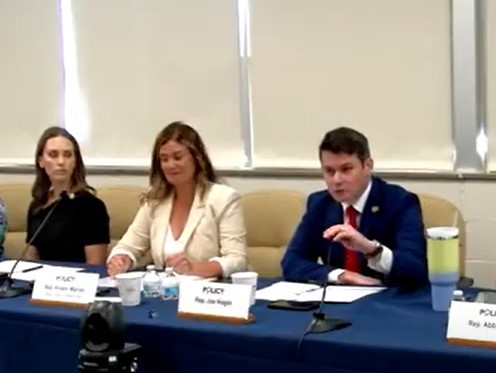
The announcement came during a Republican House Policy Committee hearing at Upper Bucks County Technical School, where lawmakers heard firsthand from educators, childcare providers, business leaders, and policy experts about the acute workforce shortage gripping the state’s early childhood education sector.
Rep. Milou Mackenzie (R-Lehigh, Montgomery, Northampton) reflected on her own experience as a working mom, crediting her mother and grandmother for helping care for her children. But she noted that many of her colleagues lacked similar support—and that little has improved for parents in 2025.
The workforce gap is growing, speakers warned, and it is directly tied to childcare availability and affordability.
Aaron Riggleman, government affairs manager with the Pennsylvania Chamber of Business and Industry, painted a stark picture of the state’s labor market.
“There are 340,000 job openings in Pennsylvania right now,” he said. “But we only have 66 available workers for every 100 open jobs.”
He cited a workforce participation rate of just 61.9 percent—lower than many competing states—and noted that inadequate childcare is a major barrier keeping parents out of the labor force.
“Employers lose an estimated $2.88 billion annually in productivity due to employee absences and turnover caused by childcare challenges,” Riggleman said. “The commonwealth also loses approximately $591 million in tax revenue each year as a result.”
A report from the state’s Independent Fiscal Office predicts the working-age population in Pennsylvania will decline by 2.1 percent over the next five years. Senate Republicans estimate only a 1.6 percent population increase through 2050—far below the national average of 20 percent growth. One of the primary concerns is the exodus of younger people from the state.
Marissa Christie, president and CEO of United Way of Bucks County, testified in support of the GOP proposal, noting that more than 25,000 childcare vacancies have forced the closure of 932 classrooms across the state, leaving over 3,000 children without access to early education.
“In Bucks County, 92 percent of providers report difficulty hiring teachers,” she said. “And 85 percent had unfilled positions in 2024, forcing them to reduce enrollment or close classrooms.”
Low wages and high credentialing costs are major barriers to hiring and retention, she added.
Bernadette Rodrigo, director of Children’s Village in Doylestown, said her center has averaged six vacant positions each week over the past 10 months—including three lead teachers. More than 200 families are on the waiting list.
“We offer $16 an hour to start, which is above average,” Rodrigo said. “But most applicants turn us down because of the salary.”
Tiffany Marin, owner of Teddy Bear College Preschool in Bensalem, echoed those concerns.
“The staffing crisis isn’t new; it’s ongoing and getting worse,” she said. “We’re dealing with constant turnover, a shrinking applicant pool, and rising expectations.”
She also highlighted the burdensome costs of onboarding new employees, including background checks, health forms, fire safety, and mandatory training—costing $200 to $300 per hire.
“If a new employee backs out halfway through the process, that money is lost,” Marin said. “We’re not against oversight—we’re asking for real investment and support.”
Rep. Kate Klunk (R-York) emphasized the broader implications of the childcare shortage.
“We need families in Pennsylvania,” she said. “We need to grow the state. We need a sustainable workforce.”
Hogan noted that the state’s fragmented regulatory framework is part of the problem.
“Three different state agencies—the Department of Human Services, the Office of Child Development and Early Learning, and the Department of Education—are all regulating this sector, often with contradictory rules,” he said. “We can’t keep throwing money at the problem and expect it to go away.”
Policy Committee Vice Chair Kristin Marcell (R-Bucks) said the hearing offered a clear view of the disconnect between regulatory intentions and the realities faced by families and providers.
“When working parents cannot find care, they cannot fully participate in the workforce,” Marcell said. “We need solutions that reflect the real challenges families and providers are facing.”
Mackenzie agreed, urging society to place greater value on early childhood education.
“In Lehigh County, warehouse jobs for unskilled workers are paying $28 an hour,” she said. “We’re asking childcare providers to do far more, for far less.”